

Courtesy
of Dr. Goldens artistry, I sport beautiful porcelain
laminates that look entirely natural. But most importantly,
I no longer get a sick feeling in the pit of my stomach
any-more at the thought of going to the dentist. Perhaps
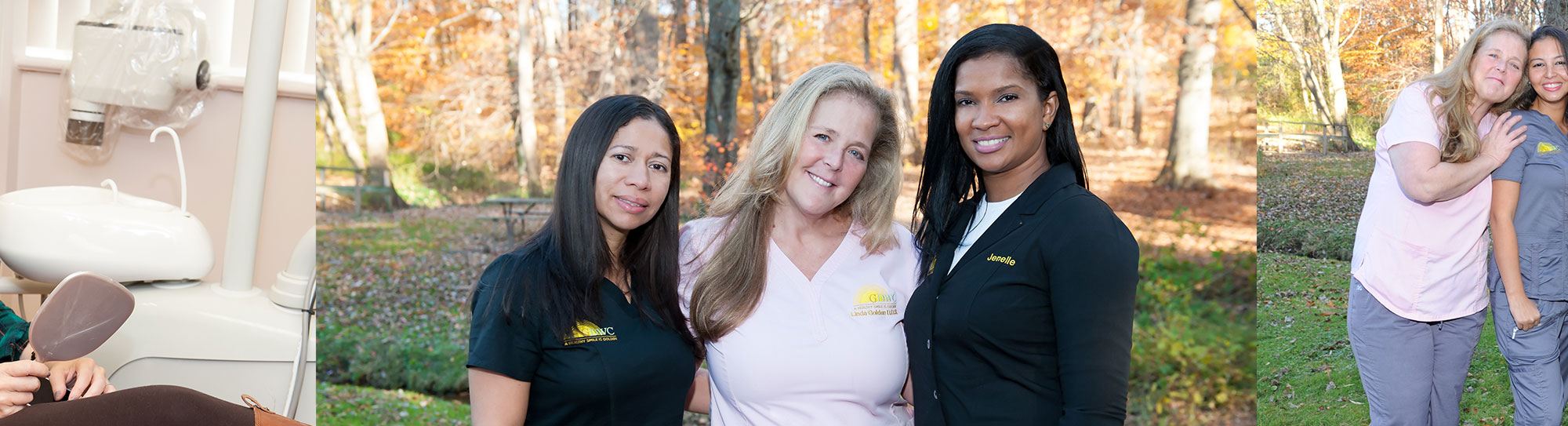
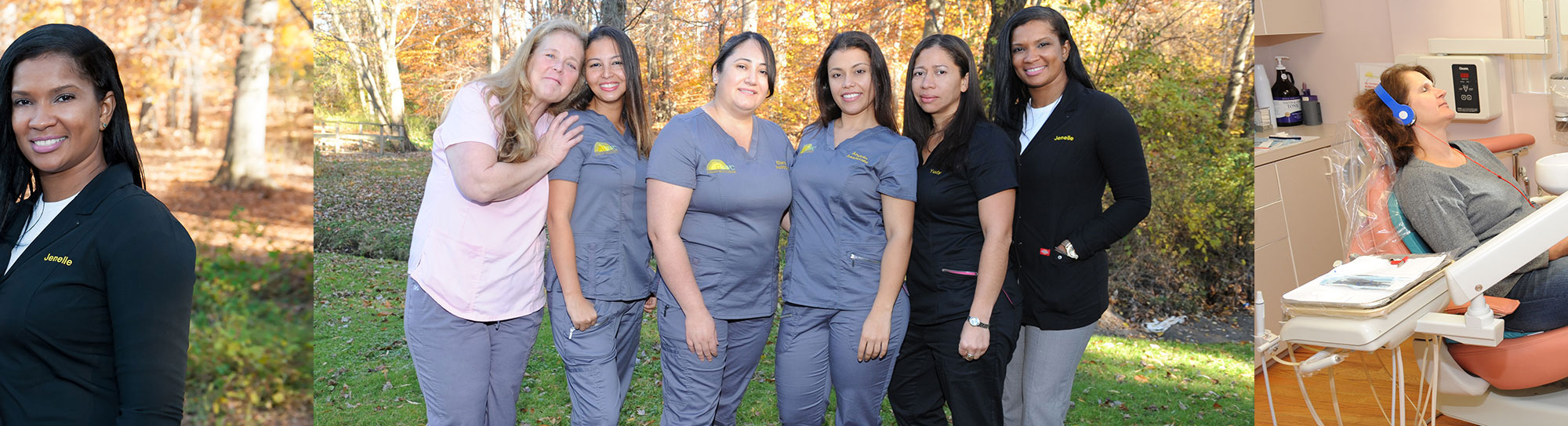
its because the minute I walk into Dr. Goldens
office, I can plunk myself down in her deluxe massage chair,
or better yet, take advantage of a on-premise masseuse who
uses a combination of Swedish and shiatsu techniques to
get the kinks out of my neck and back. Later as Dr. Golden
works on me, the masseuse works reflexology magic on my
feet and hands. Most of the time, I feel like Im at
a spa instead of at the dentist and thats just fine
with me.
"I
do try to create a spa-like atmosphere to help my patients
relax," says Golden. "While in the chair, patients
can relax, watch a movie (on video, complete with headphones),
get a massage, listen to music. We also offer them coffee
or tea, ad a blanket t rest with before, during and after
treatment. An added benefit is that when my patients are
relaxed, I can on their teeth with a minimal pressure from
them to get it done faster."
What
Is Holistic Dentistry?
Holistic
dentistry recognizes the relationship between the mouth
and overall health and tries to enhance the patients
health and well being while doing the least amount of harm
in any course of treatment, according to the Holistic Dental
Association in Durango, CO. Since dentists cant get
specialized training or accreditation in "holistic"
forms of dentistry, most, like Dr. Golden, are satisfied
to simply apply the principles to their practices in a number
of ways.
"We
do everything that a regular dentist would do, except we
understand the relationship between how the teeth can affect
the rest of the body, based on the nutrition and lifestyle
habits of the person," says Reid Winick, DDS, a Manhattan
and Manhasset, NY-based holistic dentist.
Kristina
Saljanin, 30, who admits to having been "petrified
by dentists" in the past, is thrilled with her treatment
by Dr. Winick. She especially liked that his assistant rubbed
an acupuncture pressure point between her index finger and
thumb while she got an injection so she wouldnt feel
the needle too much. "He also suggested I get myrrh
oil and rub it on my gums after he worked on a cavity, and
he gave me a sugar-and fluoride-free toothpaste and oral
rinse, and recommended I use an oral irrigator instead of
flossing."
Cor
Van Huemen, 41 from Kansas City, MO, found a local holistic
dentist to replace his amalgams. David Dowling, DDS, tested
him for allergies to standard dental products, suggest epoxies,
fillings and crown replacements, and tested each tooth for
its polarity, to see which he needed to work on first. "He
also suggested I take coQ10 and vitamin E in limited amounts.
Ive been thrilled with the results."
CoQ10,
available as a dietary supplement, is a natural substance
used by every cell in the body to produce energy. Some experts
believe it can help reduce blood pressure. It is also frequently
used by people suffering congestive heart failure.
Hand
On Healing
Simple
relaxation techniques can go a long way in dental treatments.
A study at Case Western Reserve University in Cleveland
showed the use of a warm eye mask and a massaging pillow
can reduce pain, according to Dr. Andre K. Mickel, DDS,
MSD, an endodontist (root canal specialist) in private practice
who headed the study. In his practice, Mickel offers patients
herbal tea and soft, classical music.
Restoring
Natural Balances
Many
conventional dentists have adopted at least some form of
holistic practices. Stephen Z. Wolner, DDS, a Manhattan-based
dentist, uses a non-surgical treatment for bacterial-caused
periodontal disease. Bacterial periodontal disease, according
to the American Academy of periodontology, strikes more
than 75% of American over the age of 35 and is the primary
cause of tooth loss in US adults.
The
most common method of treating periodontal disease is surgery-a
painful, expensive and often ineffective treatment.
"I
believe that surgery should be the last resort, not the
first," says Wolner, who restores the natural balance
of bacteria in the mouththrough a three-month regimen of
antibiotics, boasting a 95% success rate.
"I
use an ultrasonic cleaning device in conjunction with antiseptics
to reduce bacteria to extremely low levels, and when necessary
I prescribe an antibiotic for acute infections. I also recommend
supplements, such as coenzymeQ10 (120 milligrams), vitamin
E (400 IU), calcium (1200 milligrams) and vitamin D (400
IU), which is essential for optimum calcium absorption,"
says Dr. Wolner , whose home care program also involves
the use of an electric power toothbrush, tongue cleaning
device and an oral irrigation unit. Other suggestions: limit
red meat to no more than once or twice a week, as its high
level of phosphorus may lower your calcium absorption, and
avoid cola and caffeinated coffee.
Dr.
Winick also uses a non-surgical, nutritional approach to
gum and periodontal disease, favoring herbal medicines and
supplements. "We use a number of natural oil/herb based
formulas that are preservative, chemical, and fluoride-free,
with which to kill bacteria. We also use a magnetic irrigator,
that I tell my patients to add antimicrobial tea tree oil
to. Not only is the bacteria killed this way, but the water
is polarized, so it repels bacteria from teeth." Dr.
Winick recommends his patients supplement with antioxidants,
such as vitamin C, vitamin E, garlic (90-100 milligrams),
coenzyme Q10, and grapeseed extract.
The
Amalgam Conundrum
Although
the American Dental Association (ADA) reassures us that
the silver/mercury amalgam filling, which have been used
to fill cavities for the past 160 years, are perfectly safe,
others disagree. Organizations such as The Holistic Dental
Association, The Foundation for Toxic Free Dentistry and
the International Academy of Oral Medicine & Toxicology
oppose the use of silver amalgams, believing that the mercury
in amalgam is linked to health problems.
According
to Michael F. Ziff, DDS executive director of the International
Academy of Oral Medicine and Toxicology, an antimercury
organization, several countries, including Sweden, Denmark,
Austria, Germany, England and Canada, have issued advisories
stating that mercury-containing amalgams can be dangerous
in the mouths of children under the age of six, people with
kidney problems and pregnant women. A 1997 report by the
US Environmental protection Agency says nothing deposits
more inorganic mercury into the body than feelings. Silver
amalgams have been shown to be responsible for increasing
mercury, a problematic substance in the body (Arch Environ
Health 1996 May-Jun, 51(3): 234; Schweiz Monatsschr
Zahnmed 1994, 104(11): 1336-40; J Dent Res 1998
Mar, 77(3): 461-71).
Newer
porcelain, ceramic and resin filling cost about 20% to 100%
more than amalgams and many insurance companies wont
cover the difference. Before removing amalessential fatty
acids, flaxseed, evening primrose oil, DHAs, plus drink
a lot of water and exercise."
Tools
of the Trade
Many
holistic dentist are using lasers in place of traditional
drills along with alternatives to amalgam fillings. Dr.
Richard Hansen, DDS, in Fullerton, CA, uses a Hydrokinetic
hard tissue laser that uses sterilized water to cut enamel,
dentin and carry away decay, without the need for anesthesia,
needles or the drill. Because the laser cauterizes nerve
ending, expose and infected tissue feels less sensitive.
In
other offices, people uncomfortable with the noise and vibration
of a drill can opt for air abrasion, where a thin stream
of aluminum oxide particles driven by compressed air sprays
away tooth decay, on or close to the surface of the teeth.
Because the tool used is non invasive, no anesthetic is
usually required, making it an ideal treatment for small
children of fearful patients
like me.
All
of these kinds of measures are changing the face of dentistry
to a kinder, gentler profession.
The
term "periodontal" means "located around
a tooth," and periodontal disease infects gums or other
teeth-supporting structures.
Gingivitis,
inflammation of the gums, describes the early and reversible
stage of periodontal disease.
Nearly
20 percent of working Americans between the ages of 55 and
64 suffer advance gum disease. Left untreated, periodontal
disease loosens teeth, hampers speaking and chewing and
causes tooth loss.
Plaque
(colorless, sticky film that constantly forms on the teeth
and contains bacteria, mucus and food particles) under the
gum line is one of the main causes of gingivitis. When bacteria
in plaque contact sugars and starches in our mouths, the
bacteria produce an acid that attacks tooth enamel, leading
o tooth decay. The gums become infected, causing pockets
to form between teeth and gums that trap more plaque. Left
untreated, gingivitis (puffy, red, bleeding gums) makes
way for advance periodontal disease, destroying bone in
the jaw and its supporting tissues.
As
we age, gum disease replaces cavities as the greatest tooth-related
concern. The good news: just two visits to the dentist each
year combined with impeccable oral hygiene can save your
teeth by preventing or curing gingivitis. But the key to
healthy pearly whites is excellent oral care at home.
Good
Home Care
Spend
time on your teeth. Allow 15-20 minutes each night before
bedtime to floss, brush and use an herbal rinse. Follow
flossing by brushing with a soft, small-headed toothbrush.
Dont scrub side to side; doing so destroys tooth enamel.
Move the bristles in circular motions over teeth and gums.
When
youre done brushing, use a gum stimulator to apply
gentle pressure taps on the gum between your teeth.
An Ounce
of Prevention
When
youre through brushing, swish a capful of herbal rinse
in your mouth for 30 seconds. Aside from leaving fresh scent
and taste, an herbal rinse may help soothe swollen, irritated
gums and make your mouth feel better.
Herbs
benefit the gums the same way they benefit the skin.
Good-for-the-gums
herbal rinses include:
- Echinacea,
used by Native Americans to treat abscesses and wounds;
fights bacteria and stimulates the immune system.
- Goldenseal,
also used by Native Americans, treats wounds and inflammation.
- Grapefruit
seed extract, reputed to kill germs.
- Bloodroot,
a Native American remedy once used to treat skin ulcers,
is now linked to preventing cavities and destroying germs
that cause plaque
- Calendula,
a natural antiseptic used to treat cuts, sores and burns.
- Aloe,
an herb that treats damaged tissue.
You
Are What You Eat
A poor
diet can contribute to gum disease by causing an imbalance
in certain proteins and minerals. This imbalance allows
more bacteria to collect on the plaque on the teeth.
Holistic
dentist Victor Zeines, DDS, tells his patients "to
change their diet. The American diet of today is not fit
human consumption, because its high in fat and cholesterol
from meat. The ideal diet is largely grains, vegetables
and fruit." Meat and junk food, he says, are a major
cause of dental problems. Dr. Zeines recommends body detoxification,
an internal cleansing to rid the body of wastes.
He
suggests: Eat a natural diet, high in fruits and vegetables;
drink two quarts of distilled water each day; take a high
potency vitamin/mineral supplement; take the herb milk thistle
(a natural detoxifier); take vitamin C with bioflavonoids
(deficiencies of vitamin C are thought to allow toxins,
like those from the bacteria in plaque, to permeate, like
psyllium seed, nightly; decrease consumption of caffeinated
beverages.
The
health of your gum tissue depends on fulfilling its nutritional
needs. Make sure your diet supplies enough vitamin A as
well as Zinc. Zinc acts with vitamin A to reduce healing
time.
A deficiency
of vitamin A is thought to be a cause of periodontal disease.
Coenzyme Q10 is an antioxidant, which, according to Dr.
Zeines, can help reverse periodontal disease, Vitamin E
and selenium, too, have been shown to have beneficial affects
against periodontal disease.
According
to Dr. Zeines, "Healing can be enhanced by good diet
rich in nutrients and high in fiber with a decrease or absence
of caffeine and smoking. By changing the bodys chemistry
and enhancing the immune system, periodontal problems can
be greatly reduced."
Back to Top